Every visitor's audio guide. In their language.
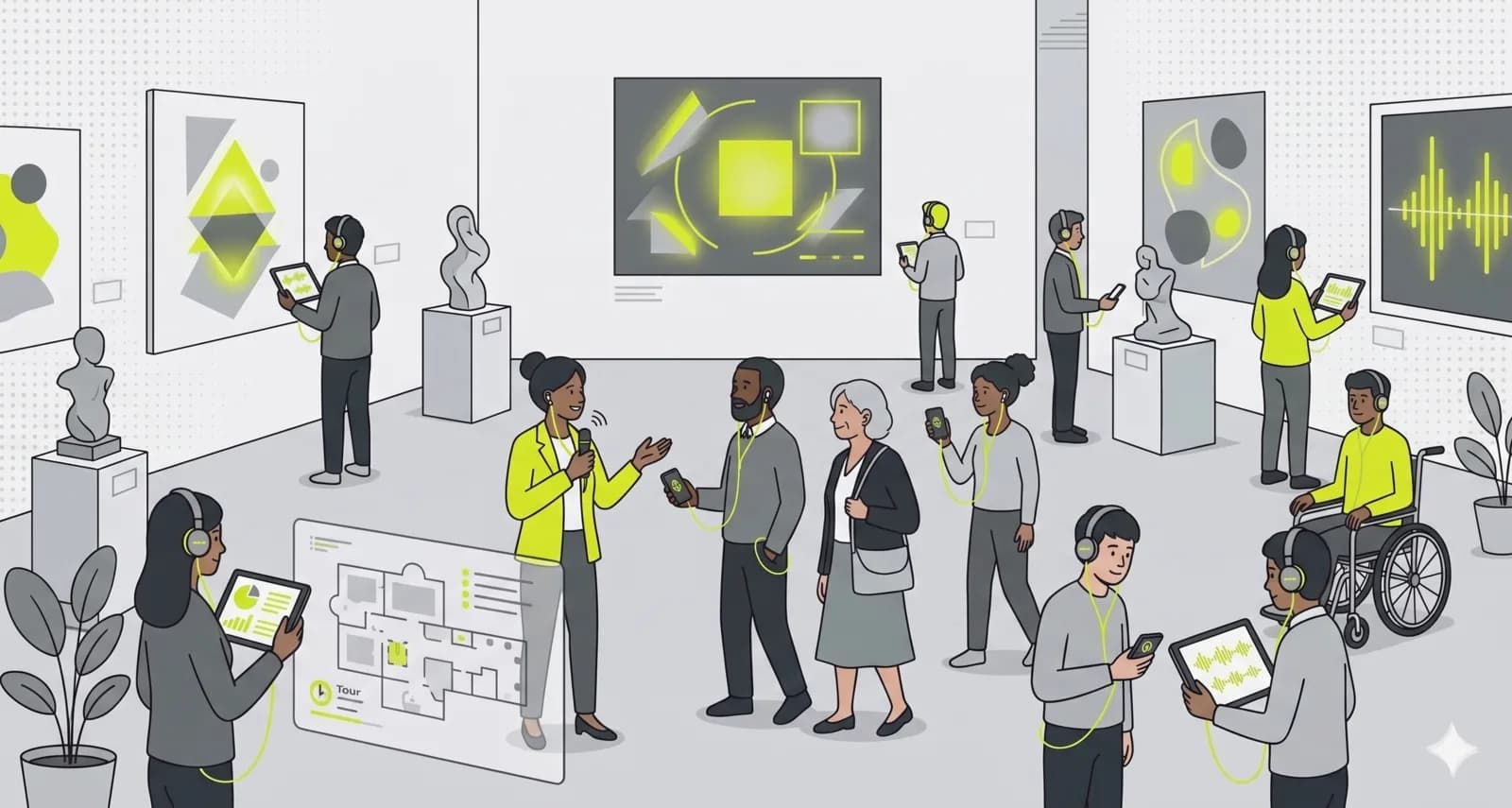
A special exhibition, a school group, a city walk, a factory tour. Instead of handing out receivers and headsets, you point people at a QR code. They scan, pick their language and hear the guide live on their own phone, with subtitles or a translated voice. Visitors who are blind or have low vision get spoken audio description on the same channel. Nothing to rent, count, clean or recharge between groups.
What matters most.
An audio guide in every language
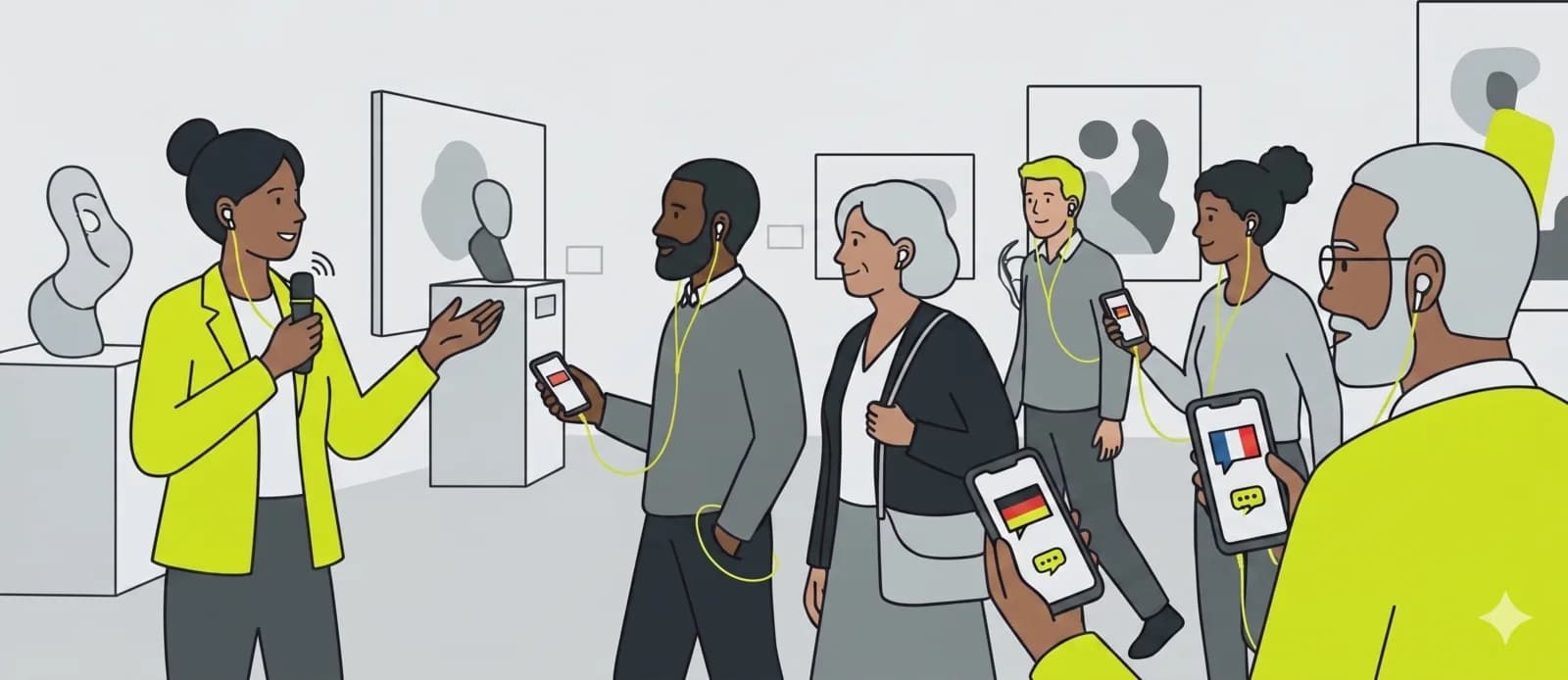
Visitors scan a QR at the entrance or next to an exhibit, pick a language and listen. One channel serves a German, English and Spanish group at the same time, with no separate tour per language and no booking desk.
No receivers, no headsets
People use their own phone and earphones. Almost everyone carries one, and a basket of simple earphones at the desk still costs far less than a set of audio-guide devices to buy, charge, clean and replace.
Audio description built in
Add a spoken description so visitors who are blind or have low vision follow the exhibit on the same channel. Live subtitles help in loud halls and for hard-of-hearing guests. Accessibility without a second system.
What actually replaces the audio-guide cabinet.
The device itself is rarely the expensive part. The cost sits in everything around it: a member of staff who hands units out and takes them back, a deposit or an ID held at the desk, wiping earpieces between groups, charging overnight, chasing the two that walked out of the building, and replacing the ones that no longer hold a charge. That work repeats every single day the museum is open.
When visitors listen on the phone already in their pocket, all of it disappears at once. There is nothing to sign out, so the queue at the desk gets shorter, and nothing to return, so the queue at closing time disappears entirely. A basket of simple earphones for people who forgot theirs covers the gap, and it costs a fraction of even one replacement audio-guide unit.
What you give up is control over the hardware. You cannot guarantee every visitor has a charged phone, and a few will not want to use their own. That is why the basket at the desk matters, and why keeping a handful of old units for the rare visitor who needs one is a reasonable middle path rather than an admission of defeat.
Live guiding and self-guided listening are different jobs.
On a moving tour the guide wears a headset or lapel microphone and simply talks. Visitors hear it in their own earphones, which changes how a group physically behaves: nobody has to crowd in close to hear, the group spreads out, and the guide stops raising their voice in a room where other people are trying to look at things. It also means a visitor can stand two rooms back finishing a painting and still hear what is being said.
A fixed exhibition works the other way round. You record the commentary once, per exhibit or per route, and visitors play it at their own pace by scanning a QR next to the object. Nobody is waiting for a group to catch up, and the recording can be translated afterwards from the complete file, which is more accurate than anything produced live.
Both run from the same channel, and most museums end up using both: recorded commentary for the permanent collection, live guiding for tours and special exhibitions where a curator is actually present.
Audio description asks something of the guide.
Adding a spoken description track for blind and low-vision visitors is straightforward technically. The harder part is what goes into it, and no software solves that. A guide who says "as you can see here" has already lost half the room, and a guide who says "the figure on the left is turned away from us, one hand raised" has not.
It is worth briefing guides on this once. Describe position, scale, colour and what is happening before interpreting it, and give the visitor the thing itself before giving them your reading of it. Guides who learn this tend to report that their tours got better for everybody, not only for the visitors who needed the description.
Live subtitles cover a different need on the same channel. In a loud hall, near an interactive exhibit, or for a hard-of-hearing visitor, reading along solves a problem that no amount of volume will. One setup, several accessibility needs, and nothing extra to hand out.
Phones against rented hardware.
How listening in the browser compares with the two systems museums and tour operators already use. The differences are mostly operational rather than technical.
| Criterion | OpenBooth | Rented audio guides | Tour headset system |
|---|---|---|---|
| Upfront cost | No hardware | One unit per visitor | Transmitter plus receivers |
| What the visitor uses | Own phone and earphones | A device from the desk | A receiver from the guide |
| Deposit or ID | Nothing to leave | Usually required | Usually required |
| Between groups | Nothing to do | Collect, wipe, recharge | Collect, wipe, recharge |
| Staff at the desk | Point at the QR code | Hand out and take back | Hand out and take back |
| Languages at once | Several | One per unit | One per channel |
| Subtitles | Yes | No | No |
| Audio description | Same channel | Separate track if bought | No |
| Self-guided playback | Yes | Yes | No, live only |
| Losses and breakage | None | Ongoing | Ongoing |
Keeping a small number of loan devices is still sensible for visitors without a phone or a charged battery. The point is that it becomes an exception to handle, not a fleet to operate.
How to set it up.
- 01
Create a channel
One channel for the permanent collection, one per special exhibition or tour. Each gets a permanent URL and QR code.
- 02
Connect mic, pick languages
The guide speaks into a headset or lapel mic. Choose the languages your visitors need; the translated voice and subtitles follow live.
- 03
Place the QR codes
At the entrance, on the ticket, beside an exhibit or on the tour flyer. Visitors scan and pick their language in seconds.
- 04
Guide live, or pre-record
Speak live on a moving tour, or record a commentary once and let visitors play it at their own pace. Both run from the same channel.
One museum, one special exhibition.
Three languages, a school group, and nothing handed out at the desk.
A city museum opens a special exhibition expected to run four months. Visitors come from the region, from a nearby border area, and in booked school groups. Previously each guided tour meant counting out receivers, taking deposits, and collecting everything again at the end.
Setup takes an afternoon. One channel for the special exhibition, German as the spoken language, English and Spanish as translations, plus a spoken audio-description track recorded by the curator who wrote the exhibition texts. A QR code goes on the ticket, on a sign at the entrance, and on the wall panel in the first room.
On an ordinary Tuesday a curator guides a group of eighteen through the rooms while wearing a lapel microphone. Some of the group listen in German, two Spanish-speaking visitors follow the translation, and a visitor who is blind listens to the description track. Nobody crowds in to hear, so the group spreads across the room instead of forming a ring around the guide. A school group that arrived without booking scans the same QR and follows the recorded commentary at their own pace in the next room.
The desk handed out four pairs of earphones from a basket that morning. It collected nothing back at closing time.
- Languages
- 3 + description
- Devices handed out
- 0
- Deposits taken
- 0
- Setup
- One afternoon
Common questions.
For most settings, yes. Visitors listen on their own phone and earphones, so there is no hardware to buy, charge, clean or hand out. You can keep a few simple earphones at the desk for anyone without their own, which is still far cheaper than a fleet of audio-guide devices.
Related use cases.
Hardware out. Every language in.
Give every visitor a guide in their language without renting a single receiver. Channel and broadcast-time limits vary by plan, see pricing for details.